By Dan Joandrea, Total House Inspection Inc.
A standard home inspection is thorough. A good inspector works through a long checklist covering every major system: roof, foundation, electrical, plumbing, HVAC, attic, and more. But every single one of those checks depends on what the inspector can actually see. That’s the limit, and it’s a real one.
Hidden moisture sitting in insulation above a dry ceiling. An overloaded breaker that looks perfectly normal with the panel cover on. An insulation gap behind drywall that’s been quietly bleeding heat for years. None of these leave visible clues until the damage is already done. This is the gap that infrared thermography is designed to fill, and the question worth asking honestly is: is thermal imaging worth it for a home inspection, and does that gap matter enough to pay extra to close it?
After thousands of inspections, the answer isn’t “always yes” or “it’s just an upsell.” There are clear patterns for when a thermal imaging scan changes the outcome for a buyer, and when it adds less value. Here’s the straight version.
What a standard visual inspection actually misses
The real limits of eyes and a flashlight
Even a thorough standard inspection only covers visible, accessible surfaces. An inspector identifies what they can observe directly: stains, cracks, signs of wear, deteriorated materials, code violations, and operational failures. That’s the job, and a qualified inspector does it well. The problem is that some of the most costly defects remain hidden until they’re well advanced, and by then, the repair bill has already started climbing.
Consider a ceiling with no water stain, no discoloration, no visible sign of anything wrong. That ceiling can still have active moisture sitting in the insulation above it, fed by a slow roof leak that hasn’t fully saturated the drywall yet. By the time the stain appears, the insulation is saturated, the roof decking may be compromised, and mold has had weeks to establish itself. The visible clue shows up well after the damage is done.
Why some defects stay invisible until they're expensive
Three categories of problems are most likely to slip past a visual-only inspection. Moisture that hasn’t broken through a surface yet. Electrical components that run hot under load but look fine with the panel cover in place. Insulation gaps inside wall cavities that show no sign from either side of the wall. These aren’t rare edge cases. Moisture intrusion and insulation failure are among the most common and costly problems in residential homes, and they’re especially prevalent in colder climates like Michigan’s, where freeze-thaw cycles stress building envelopes year after year.
This is the exact gap a thermal camera inspection is designed to fill. It doesn’t replace the visual inspection, it extends coverage into areas where eyes alone can’t reach, catching problems at the stage where they’re still manageable.
Is thermal imaging worth it for a home inspection?

Hidden moisture and active water intrusion
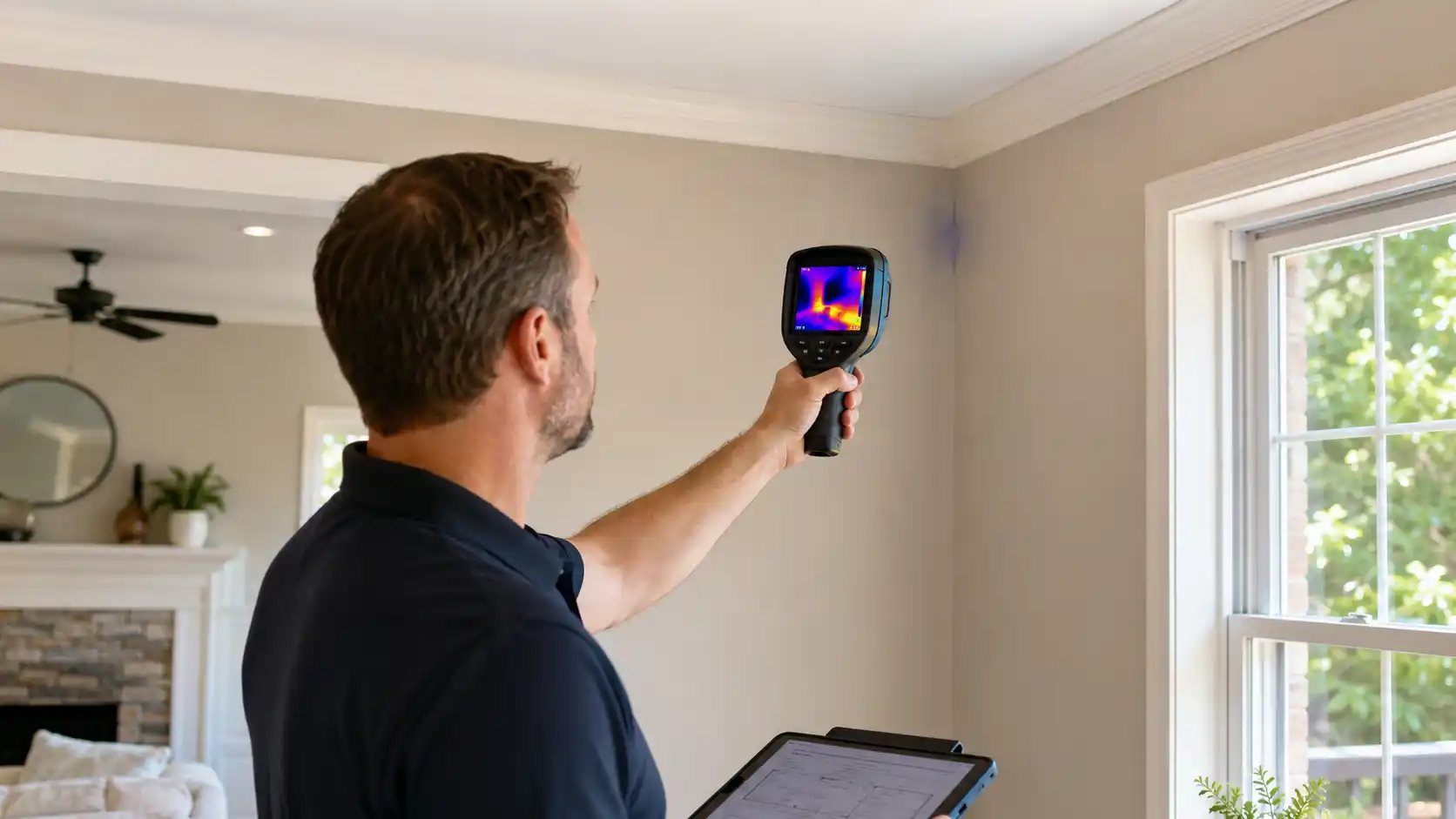
Wet materials hold and release heat differently than dry materials. An infrared (IR) scan picks up those surface temperature differences and flags areas where moisture is likely present, even when there’s no stain, no drip, and no visible evidence of any kind. The camera doesn’t see moisture directly; it sees the temperature anomaly that moisture creates. Common sources that IR scanning catches include roof leaks, plumbing leaks inside walls, foundation seepage, and condensation around windows and HVAC equipment.
The confirmation step matters here. A thermal camera flags the anomaly, and a moisture meter verifies it. That combination is where accuracy climbs significantly, field data supports detection rates above 95% for active moisture when both tools are used together by a trained inspector. The scan points to the problem; the meter confirms it.
Electrical hotspots and overloaded circuits
Overheating electrical components produce a clear heat signature. Breakers running above capacity, loose connections at terminals, and failing components all show up as hotspots when an infrared thermography scan images the panel surface under load. The entire panel can be imaged in seconds, and the results are documented with thermal photos in the report. A visual inspection can’t match that, the panel cover goes back on and no visible clue exists.
Electrical fires frequently originate from faults that look completely normal from the outside. According to the NFPA, loose and faulty connections account for roughly a quarter of all major electrical failures, and these are exactly the kinds of faults that show up as heat anomalies on an IR scan. Thermal imaging finds those faults at the stage where they’re still a relatively minor fix, not after they’ve caused damage or worse. This is one of the strongest safety arguments for adding a scan, especially in older homes with aging electrical systems.
Insulation gaps and energy loss
Missing or damaged insulation creates a direct path for heat to escape in winter and enter in summer. A thermal scan reveals these gaps as temperature anomalies across walls, ceilings, and attic floors, showing exactly where the building envelope is failing. Beyond comfort, insulation gaps drive up energy bills year-round, and identifying them before closing gives buyers concrete negotiating leverage.
One important limitation to note: thermal imaging shows where insulation is missing but doesn’t measure R-value. It’s a locator, not a quantifier. It tells you something is wrong and where; it doesn’t tell you the precise performance level of what’s there. That’s fine for inspection purposes, but worth understanding when you read the report.
Real-world examples: what infrared catches before it costs you
The roof leak that had no visible evidence
Picture this scenario: a home passes visual inspection with no water stains on any ceiling. Clean walls, no discoloration, nothing flagged. The thermal imaging scan then shows a cool, irregular pattern along the exterior wall of an upstairs bedroom. A moisture meter confirms active moisture in the area. The source turns out to be a failing flashing around a skylight, one that’s been leaking slowly for months without saturating the drywall enough to stain it.
Left undetected, that kind of leak damages roof decking, saturates insulation, and compromises drywall, repairs that can easily run into several thousand dollars once mold remediation and structural work are factored in. The NRCA and building science research consistently show that infrared surveys of roofs identify 85 to 95 percent of significant wet insulation areas that visual inspection would miss entirely. That’s not a marginal improvement; that’s a fundamentally different level of coverage.
The electrical panel that passed a visual check
An older home with a recently replaced panel cover. Visually, the panel looks clean and updated. Under IR, two breakers show elevated heat signatures indicating they’re running over capacity. The fix is relatively minor. A licensed electrician addresses the overloaded circuits before closing, and the buyer has documentation of the issue and its resolution. Without the scan, neither party knows about it until something fails.
This scenario illustrates the core value of thermal imaging in a home inspection: it finds problems while they’re still cheap to fix, not after they’ve caused damage. The repair cost is small; the risk it eliminates is not.
The honest limitations of thermal imaging
When IR scans fall short
Thermal cameras detect surface temperature differences, not moisture or electrical faults directly. If a problem hasn’t created a temperature anomaly at the surface, the scan won’t catch it. Dried-out leaks don’t register. Problems buried deep behind thick materials or well-insulated cavities may not produce a readable signal at the surface. Thermal imaging also can’t see reliably through glass or polished metal surfaces, which reflect infrared energy rather than emitting it.
Results also degrade significantly in low-contrast conditions. Building envelope scans depend on a meaningful temperature differential between inside and outside, typically at least 18 degrees Fahrenheit, to produce useful results. On a mild spring day when interior and exterior temperatures are close to equal, the scan loses much of its diagnostic value for insulation and air leakage. Timing the scan appropriately, with qualified equipment and an inspector who understands building thermography, matters as much as having the camera.
False positives and why interpretation matters
Not every anomaly on an IR image is a defect. Reflections from shiny surfaces like tile, glass, and metallic finishes can make the camera display apparent heat sources that don’t actually exist. Solar loading on exterior walls during the day can create misleading hot spots. Normal temperature variation in building materials can produce patterns that look alarming to an untrained eye but indicate nothing problematic.
This is why the inspector’s training matters as much as the equipment. A poorly interpreted IR scan creates unnecessary alarm, generates requests for repairs that aren’t needed, or misses the actual issue entirely. A trained inspector with proper thermography credentials makes thermal imaging a powerful screening tool. Without that training, it’s unreliable and potentially misleading for everyone involved.
What it costs and how to add it to your inspection
Typical cost range for an IR scan
As a standalone service, a dedicated infrared thermography inspection typically runs $200 to $500. As an add-on to a standard home inspection, expect to pay $50 to $200 more, depending on home size, layout complexity, and the inspector’s equipment. Larger homes with multiple levels, finished attics, or complex HVAC systems cost more because a thorough scan takes longer and covers more surface area.
Put that cost in context. Water damage repair from hidden moisture intrusion averages $3,300 to $3,900 nationally, and can run significantly higher once mold remediation and structural work are added. The add-on price for an IR scan is modest against those numbers. For most buyers putting significant money into a home, the math clearly favors adding the scan.
Qualifications worth checking before you book
Look for inspectors with specific thermal imaging credentials, not just an inspector who owns a camera. The InterNACHI Infrared Certified designation is a widely recognized residential thermography credential, requiring completion of certified home inspector requirements plus an approved thermography course. The Certified Residential Thermographer (CRT) designation through Monroe Infrared is another respected credential, recognized by major home inspector associations and valid for three years.
Beyond credentials, ask whether the inspector uses a thermal camera built for building diagnostics rather than a consumer-grade imager, and confirm that thermal images are documented directly in the written inspection report. You want findings from the IR scan integrated with the rest of the inspection, not delivered separately on a sheet with no context.
At Total House Inspection, thermal imaging is part of the advanced inspection toolkit available as part of a full-service inspection. IR findings, moisture meter verification, and the complete visual inspection all come back in a single unified digital report, no coordinating two separate vendors, no reconciling two separate documents. For buyers in southeast Michigan, that streamlined approach saves time and keeps every finding in one place.
When a thermal imaging home inspection is worth the cost
The honest answer depends on the property. For older homes, any property with a history of moisture issues or high energy bills, homes with aging electrical systems, and Michigan homes that have been through decades of freeze-thaw cycles, adding an infrared scan is worth doing without much deliberation. The probability of finding something significant is high enough that the cost is easy to justify.
For newer construction in good documented condition, it’s a reasonable add-on but less urgent. Newer, tighter-built homes simply carry a lower risk profile than older stock, they haven’t had the years of weather cycling, deferred maintenance, and system wear that make hidden defects more likely. A thorough visual inspection covers more of the relevant territory in that scenario.
Ultimately, is thermal imaging worth it for a home inspection? The real question isn’t abstract value, it’s whether you want to know what’s behind the walls before you’re legally obligated to own them. If the answer is yes, the cost of an IR scan is a small line item in a large transaction. Get the scan.
Frequently Asked Questions About Thermal Imaging Home Inspections
Thermal imaging is often worth adding because it can reveal temperature anomalies associated with hidden moisture, overheating electrical components, and missing insulation. It is especially valuable for older homes, properties with previous moisture problems, and homes with aging electrical systems.
Thermal imaging can help identify possible roof or plumbing leaks, moisture intrusion, electrical hot spots, missing or damaged insulation, air leakage, and uneven heating or cooling. It detects surface temperature differences rather than seeing the defect itself, so suspicious areas may require additional testing.
No. A thermal camera does not see through drywall, ceilings, or other building materials. It measures surface temperatures and displays patterns that may indicate moisture, missing insulation, air leakage, or excessive heat behind the surface.
Wet building materials often heat and cool differently from dry materials. A thermal camera can identify the resulting temperature anomaly before a leak creates a visible stain. The inspector should then use a moisture meter or another testing method to confirm whether moisture is present.
Thermal imaging can identify unusual heat patterns around breakers, electrical panels, connections, and other components operating under load. These hot spots may indicate an overloaded circuit, loose connection, or failing component, but further evaluation by a licensed electrician may be necessary.
No. Thermal imaging is an additional screening tool, not a replacement for a complete visual home inspection. The best results come from combining thermal imaging with visual observations, moisture testing, electrical evaluation, and the inspector’s knowledge of building systems.
As an add-on to a standard home inspection, thermal imaging commonly costs approximately $50 to $200. A more extensive standalone infrared inspection may cost approximately $200 to $500. Pricing varies based on the property’s size, layout, and the extent of the scan.
Thermal imaging is less effective when indoor and outdoor temperatures are too similar, when a past leak has already dried, or when the defect does not create a measurable surface-temperature difference. Glass, polished metal, direct sunlight, and reflective materials can also produce misleading readings.
It can be particularly valuable for Southeast Michigan homes because seasonal temperature changes and repeated freeze-thaw cycles can contribute to roof leaks, moisture intrusion, insulation gaps, and building-envelope problems. It is especially worth considering for older homes or properties with signs of water, comfort, energy-efficiency, or electrical issues.